

What Positioning Alone Can't Do For Your Business
I helped sell an agency. Here's what made it worth buying.

Most small agency owners I know are somewhere in the positioning cycle right now. Refining their niche, rewriting their website and trying to say what they do in a way that finally lands.
That work matters but it’s the beginning of the path, not the destination.
I want to tell you about an agency I helped build and eventually sell.
It was niched into orthodontics. Not healthcare broadly but orthodontics specifically.
And because of that focus, we were working alongside about 40 practices across the country, from single-location owners to multi-practice groups.
Here’s what that created: pattern recognition no one else had.
When something started shifting in how orthodontic practices needed to market themselves, we saw it early.
We didn’t have a magic crystal ball (or did we?). We were seeing the same problem play out across 40 variations of it simultaneously.
As a result we could tell a practice owner what was coming before they felt it themselves.
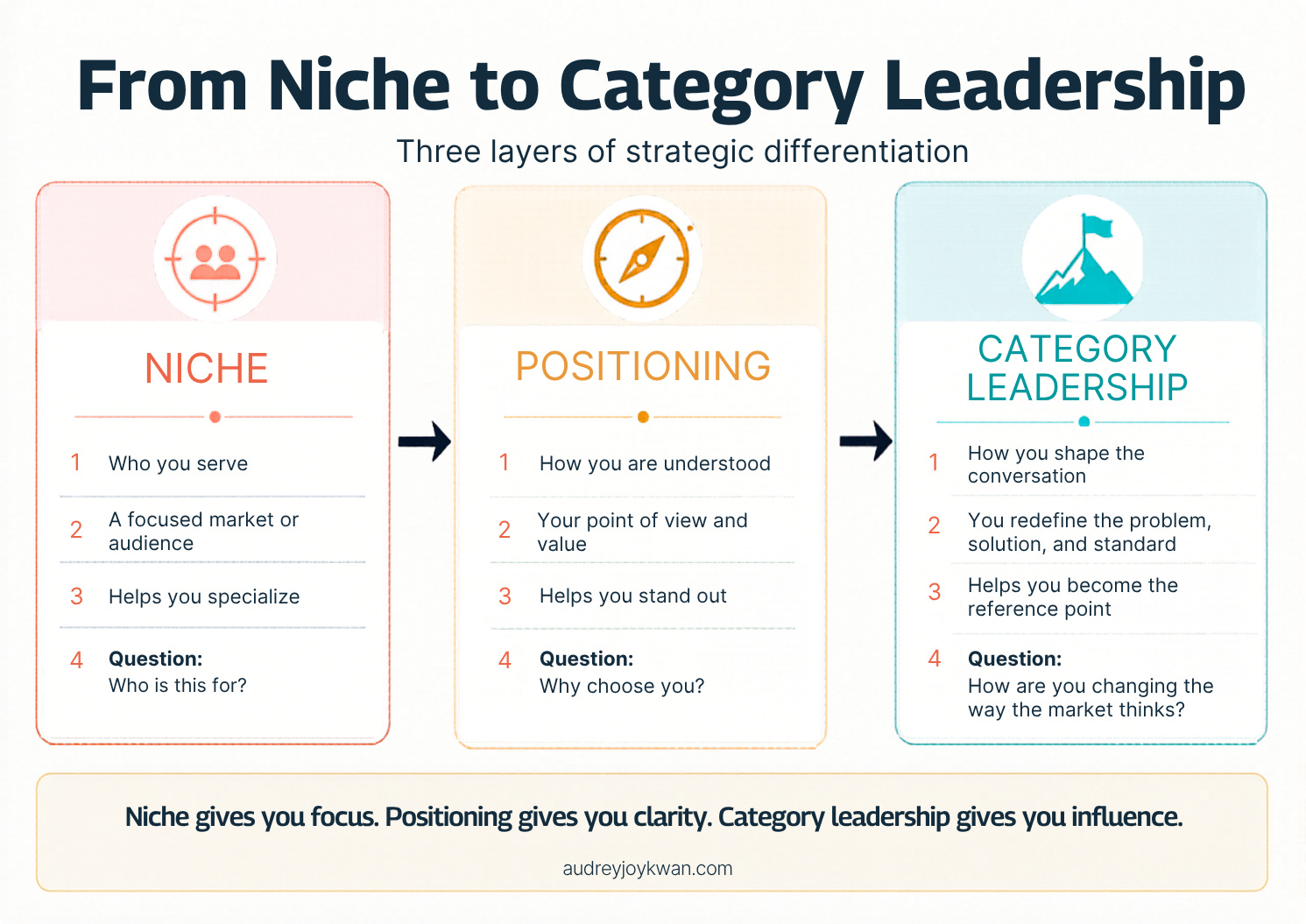
That’s not positioning, it’s category leadership.
Positioning is what got us in the room. It signaled to clients we understood their world, we’d solved this before, we weren’t a generalist who’d need six months to learn their industry.
But category leadership is what made us the business people called when they needed to understand what was actually happening in their market — it’s what made the business sellable.
And the distinction is underplayed.
Positioning explains why you’re the right fit BUT category leadership shapes how your market understands the problem in the first place and that sets you apart.
Most agencies stop at positioning.
You get the niche right, tighten the message, and wait for the right clients to find you. That’s not wrong but it leaves the most valuable part of the work undone.
Category leadership isn’t built in a day.
It’s built through the ideas you repeat, the problems you name before your clients can name them, and the way your accumulated experience lets you see around corners.
For our small but mighty orthodontics agency, the niche was the thing that made the insight possible.
You can’t see patterns across 40 practices if you’re also working with e-commerce brands and SaaS companies and local restaurants.
Focus creates intelligence.
That’s the reframe underneath everything I now call Small But Mighty.
A small, focused agency is a competitive advantage because depth creates a kind of visibility that breadth never can.
You start to see things your clients can’t see yet and when you can do that consistently, trust follows.
We’re in a market where trust is genuinely hard to earn.
Buyers are skeptical, buying cycles are long, and a well-written website isn’t enough to move someone off the fence.
What moves them is believing you understand their world better than they do.
That’s what category leadership does.
So the question worth sitting with isn’t just “how do I position myself better?” It’s this:
What does working deeply in your industry let you see that no one else can?
That’s your category leadership foundation and it’s worth more than any website rewrite.
I love how you’ve laid this out. I dabble in the first two but definitely have not reached the third.